Hi Everyone -
Well, after trying your first park jet with the Mig-29 V1, time to progress perhaps to your first "score and fold" plane. Score and fold essentially means when cutting out the plane parts, you score about half way through the foam on the designated lines, put tape on the opposite side to act as a hinge and then fold the foam along the score line in order shape 3D type fuselages, hence "score and fold". These planes are a bit more complex to build and repair than a profile plane like the Mig-29 V1, but I think look a lot better, are more streamlined and have a better "presence" in the air. They also lend themselves well to adding full control surfaces and KF (Kline Fogleman) airfoils as your building and flying skills advance.
The RC Powers F-18 V3 in my experience is an ideal plane for your first score and fold park jet. Again, it is free which is tough to beat, but is quite straight forward to build, stable, very popular and well supported. Hundreds of people have built this plane as their first score and fold park jet and have experienced great success.
As with the Mig-29 V1, it is a little outside what I consider the ideal size range for a park jet with a 30" wingspan and the angled vertical stabilizers do cause stability issues in winds over about 10 mph, but other than that it is a plane you can use to really push your skill and confidence levels and one you can "grow" into experimenting with more advanced control setups and expanded flight envelope over the Mig-29 V1. Also, the control surfaces are quite large, larger than what should be on more aerobatic and precise park jet, but for learning and building skills and confidence, they still work very well.
Here are some of the reasons why I think the F-18 V3 makes for such a great follow on to the Mig-29 V1 as your first score and fold park jet.
Well, after trying your first park jet with the Mig-29 V1, time to progress perhaps to your first "score and fold" plane. Score and fold essentially means when cutting out the plane parts, you score about half way through the foam on the designated lines, put tape on the opposite side to act as a hinge and then fold the foam along the score line in order shape 3D type fuselages, hence "score and fold". These planes are a bit more complex to build and repair than a profile plane like the Mig-29 V1, but I think look a lot better, are more streamlined and have a better "presence" in the air. They also lend themselves well to adding full control surfaces and KF (Kline Fogleman) airfoils as your building and flying skills advance.
The RC Powers F-18 V3 in my experience is an ideal plane for your first score and fold park jet. Again, it is free which is tough to beat, but is quite straight forward to build, stable, very popular and well supported. Hundreds of people have built this plane as their first score and fold park jet and have experienced great success.
As with the Mig-29 V1, it is a little outside what I consider the ideal size range for a park jet with a 30" wingspan and the angled vertical stabilizers do cause stability issues in winds over about 10 mph, but other than that it is a plane you can use to really push your skill and confidence levels and one you can "grow" into experimenting with more advanced control setups and expanded flight envelope over the Mig-29 V1. Also, the control surfaces are quite large, larger than what should be on more aerobatic and precise park jet, but for learning and building skills and confidence, they still work very well.
Here are some of the reasons why I think the F-18 V3 makes for such a great follow on to the Mig-29 V1 as your first score and fold park jet.
- Ease of build. Again, a very low parts count, only twelve total parts if you use the untiled plans (not including KF airfoils);
- Requires you to focus more on building light and strong, a habit you want to develop early in your park jet career;
- Great stability and self righting, the battery sits very low in relation to the wing plate, giving the F-18 V3 excellent self righting properties, earning it's nickname "the smart plane";
- Allows you to "grow" and learn by adding more control surfaces, KF airfoils for more precise flying, advanced aerobatics and increased flight envelope; and
- Although relatively agile, the F-18 V3 will never be a speed demon, so you can push the envelope of aerobatics while being able to stay ahead or keep up with the airplane much easier.
Ease of build
While of course not as easy or quick to build as the Mig-29 V1, once you have the parts cut out, you can essentially build the two main parts (fuselage and wing plate) concurrently which speeds up the build. After putting the reinforcement in the wing plate, hinging the control surfaces, you essentially build the "tube" of the fuselage and when everything is ready, mate the wing plate assembly with the fuselage assembly and other than adding the vertical stabilizers and electronics, you are ready to fly.
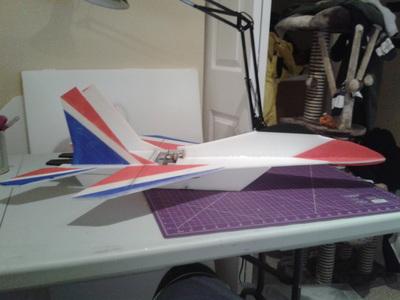
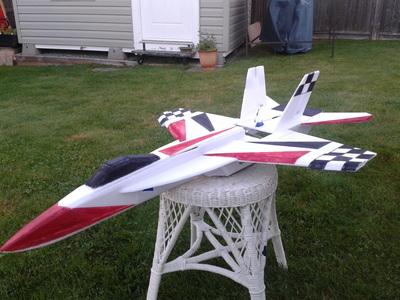
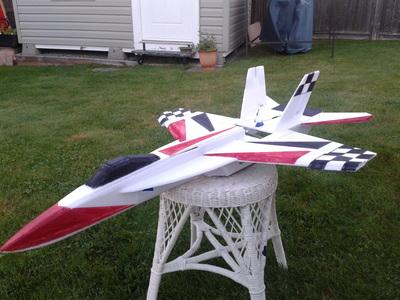
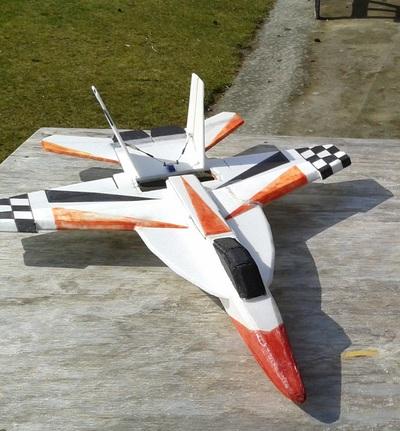
This build was my first really successful build, more on my first less than successful build later. I built this one light and simple, but still with all control surfaces and KF4 airfoils. It took about two days to complete. "Paint" job is done with magic marker for lightness and simplicity. The picture on the right is the same plane after it's 300th flight, a little faded with a new nose and a few other "blemishes", but it still flew great.
While of course not as easy or quick to build as the Mig-29 V1, once you have the parts cut out, you can essentially build the two main parts (fuselage and wing plate) concurrently which speeds up the build. After putting the reinforcement in the wing plate, hinging the control surfaces, you essentially build the "tube" of the fuselage and when everything is ready, mate the wing plate assembly with the fuselage assembly and other than adding the vertical stabilizers and electronics, you are ready to fly.
This build was my first really successful build, more on my first less than successful build later. I built this one light and simple, but still with all control surfaces and KF4 airfoils. It took about two days to complete. "Paint" job is done with magic marker for lightness and simplicity. The picture on the right is the same plane after it's 300th flight, a little faded with a new nose and a few other "blemishes", but it still flew great.
Build light but strong
With the F-18 V3 more than most any other park jet I have flown, it is very important to keep the weight down if you want to get full performance from this plane. With most power setups, you are OK up to about 22 oz/624 gr, beyond that and wing flex and wing loading will become a real problem. You can still fly the plane, but aggressive aerobatics will be a challenge and could lead to damaging the plane.
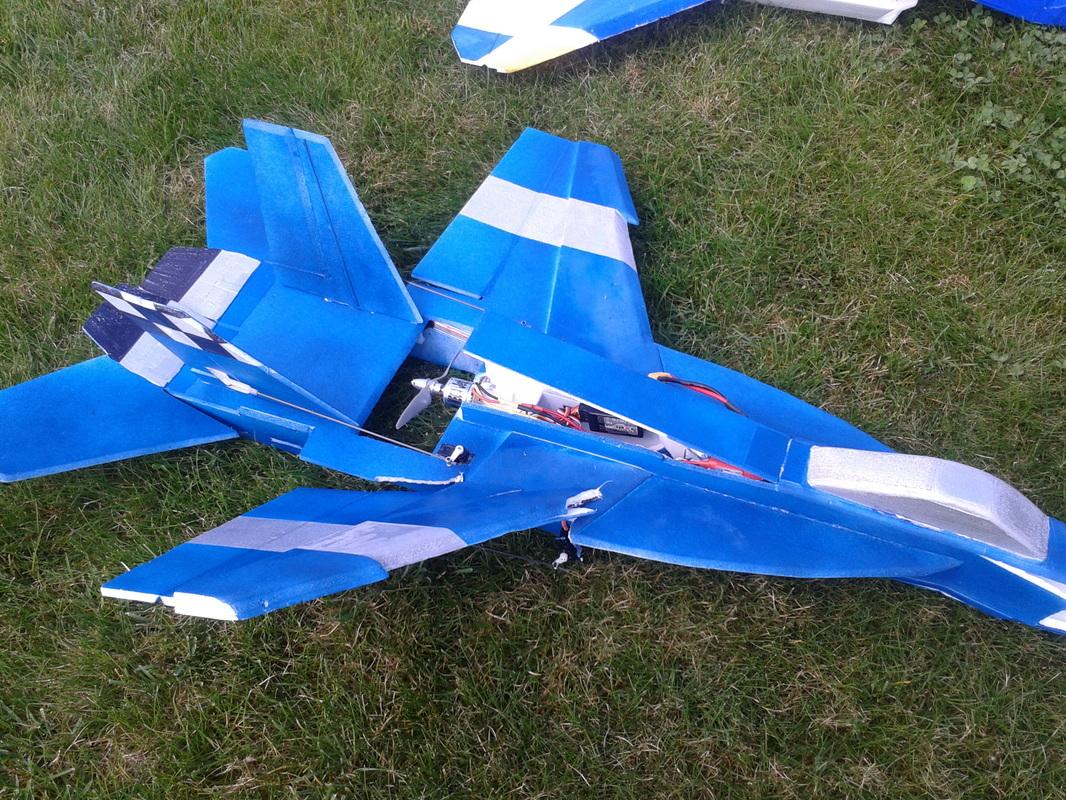
Unfortunately, I built my first F-18 V3 far too heavy (25 oz/709 gr), put a big, heavy power system in it and flew it very aggressively. Despite actually seeing some wing flex, I kept pushing the plane too hard and this was the result. The wing actually snapped in the air. So I'm not trying to be overly dramatic here, but it is important to focus on building the F-18 V3 light but strong.
With the F-18 V3 more than most any other park jet I have flown, it is very important to keep the weight down if you want to get full performance from this plane. With most power setups, you are OK up to about 22 oz/624 gr, beyond that and wing flex and wing loading will become a real problem. You can still fly the plane, but aggressive aerobatics will be a challenge and could lead to damaging the plane.
Unfortunately, I built my first F-18 V3 far too heavy (25 oz/709 gr), put a big, heavy power system in it and flew it very aggressively. Despite actually seeing some wing flex, I kept pushing the plane too hard and this was the result. The wing actually snapped in the air. So I'm not trying to be overly dramatic here, but it is important to focus on building the F-18 V3 light but strong.
Learning good techniques for building light and strong will be very important for the duration of your park jet career, so it is a good time to start with the F-18 V3. While there are lots of great lightweight glues around like Foam Cure, Foam Tac and UHU Por, if you are careful and smart about it's application, you can still build quite light with hot glue and/or epoxy. The key is to apply it very lightly and scrape off any excess from the area applied while the glue is still soft. You can always add a tiny bit more if you need to, but it is much harder and more damaging to your plane to take it off it you put too much on. Having some pieces of scrap foam, popsicle sticks or toothpicks is very handy when building with hot glue, it allows you to scrape away the excess and when you do that, you actually create a stronger bond along seams where hot glue is applied. Takes a little practice, but can be done.
I have found the ideal weight for the F-18 V3 to be about 21.5 oz/610 gr or less. On my first build shown in the first set of pictures, I saved weight by using only one servo for the rudders and "painting" with magic marker instead of paint, both these techniques saved me about 1.5 oz/42.5 gr of weight.
The "smart plane"
As mentioned already, the F-18 V3 like the Mig-29 V1 has great "self righting" qualities which adds to it's stability. The battery actually sits almost 1.5" below the wing plate, so it helps make recovering from turns and rolls much more crisp as the plane wants to be upright naturally. When still learning how a park jet handles, this increased stability makes the plane feel more smooth and docile and greatly reduces twitchy tendencies you might find in some other more advanced park jets.
A plane to "grow" with
The F-18 V3 is an excellent platform to "grow" with as a park jet pilot after flying the "elevons only" Mig-29 V1. In fact, although the F-18 V3 will fly "OK" with elevons only, it is a great candidate for elevons and ailerons combined. The larger, straighter wing can slow the roll performance down, so having the ailerons working with the elevons makes for much crisper, snappier response in turns and rolls.
If you still want to start elevons only, that is fine, I would in fact suggest cutting and hinging the ailerons and rudders and then taping them down so that adding them later is much simpler. That way you can add control surfaces as your skill and confidence increases and you want to further expand the flight envelope of your F-18 V3. Having all the controls including rudders allows you to explore slow flying and high alpha, both areas in which the F-18 V3 excels.
The F-18 V3 is also an excellent platform to start exploring the affects of KF airfoils. Personally, based on multiple tests, I would commit to either no KFs or KF4 (airfoil top and bottom). This is quite different than what most people recommend for beginners and here is why. While KF2 (airfoil only on the top) does provide more lift, it can make the plane "floaty" and the controls "mushy" if you get too slow in turns. I have had many accidents with KF2 airplanes getting "mushy" in turns and I end up losing control. KF4 give you added lift, but also added wind penetration and stability, makes handling more precise and gives the plane a much more "locked in" feeling. All things I think which are good to have when learning to fly. In testing of the NAMC Mig-35, I found that I lost about 15-20% of precision and handling with KF2 versus no KF or KF4. Hopefully although this video is from a flying wing, you can see the difference in smoothness and stability between KF4 and KF2 in the air from the airplane's perspective.
I have found the ideal weight for the F-18 V3 to be about 21.5 oz/610 gr or less. On my first build shown in the first set of pictures, I saved weight by using only one servo for the rudders and "painting" with magic marker instead of paint, both these techniques saved me about 1.5 oz/42.5 gr of weight.
The "smart plane"
As mentioned already, the F-18 V3 like the Mig-29 V1 has great "self righting" qualities which adds to it's stability. The battery actually sits almost 1.5" below the wing plate, so it helps make recovering from turns and rolls much more crisp as the plane wants to be upright naturally. When still learning how a park jet handles, this increased stability makes the plane feel more smooth and docile and greatly reduces twitchy tendencies you might find in some other more advanced park jets.
A plane to "grow" with
The F-18 V3 is an excellent platform to "grow" with as a park jet pilot after flying the "elevons only" Mig-29 V1. In fact, although the F-18 V3 will fly "OK" with elevons only, it is a great candidate for elevons and ailerons combined. The larger, straighter wing can slow the roll performance down, so having the ailerons working with the elevons makes for much crisper, snappier response in turns and rolls.
If you still want to start elevons only, that is fine, I would in fact suggest cutting and hinging the ailerons and rudders and then taping them down so that adding them later is much simpler. That way you can add control surfaces as your skill and confidence increases and you want to further expand the flight envelope of your F-18 V3. Having all the controls including rudders allows you to explore slow flying and high alpha, both areas in which the F-18 V3 excels.
The F-18 V3 is also an excellent platform to start exploring the affects of KF airfoils. Personally, based on multiple tests, I would commit to either no KFs or KF4 (airfoil top and bottom). This is quite different than what most people recommend for beginners and here is why. While KF2 (airfoil only on the top) does provide more lift, it can make the plane "floaty" and the controls "mushy" if you get too slow in turns. I have had many accidents with KF2 airplanes getting "mushy" in turns and I end up losing control. KF4 give you added lift, but also added wind penetration and stability, makes handling more precise and gives the plane a much more "locked in" feeling. All things I think which are good to have when learning to fly. In testing of the NAMC Mig-35, I found that I lost about 15-20% of precision and handling with KF2 versus no KF or KF4. Hopefully although this video is from a flying wing, you can see the difference in smoothness and stability between KF4 and KF2 in the air from the airplane's perspective.
Not a "speed demon"
With it's larger, straighter wing, the F-18 V3 is a bit "draggy". When learning this isn't necessarily a bad thing, you can certainly make it a little "slipperier" with a bit of sanding and keep it "speedier" with a very light build, but it will never be a "rocket". That is OK as you can still really throw it around the sky learning good smooth turns, loops, rolls and other advanced aerobatics, but if you need to relax and just work on the basics, it is much easier to stay up with or keep ahead of the plane as you are flying, making the flying experience more manageable and enjoyable. Besides, normally to go faster you have to add a big power system, meaning more weight which as I already mentioned is not a good thing with the F-18 V3 😐.
Certainly there are other good planes for your first score and fold park jet, but it is tough to beat the price, support and performance of the RC Powers F-18 V3 in my experience.
In the next articles, I will switch gears a bit and move towards more specifics on the different types and behaviors of park jets in general that might help you find which park jet is right for you depending on where you are in your RC career or as you look to expand your flying horizons if you are still new to flying and park jets.
With it's larger, straighter wing, the F-18 V3 is a bit "draggy". When learning this isn't necessarily a bad thing, you can certainly make it a little "slipperier" with a bit of sanding and keep it "speedier" with a very light build, but it will never be a "rocket". That is OK as you can still really throw it around the sky learning good smooth turns, loops, rolls and other advanced aerobatics, but if you need to relax and just work on the basics, it is much easier to stay up with or keep ahead of the plane as you are flying, making the flying experience more manageable and enjoyable. Besides, normally to go faster you have to add a big power system, meaning more weight which as I already mentioned is not a good thing with the F-18 V3 😐.
Certainly there are other good planes for your first score and fold park jet, but it is tough to beat the price, support and performance of the RC Powers F-18 V3 in my experience.
In the next articles, I will switch gears a bit and move towards more specifics on the different types and behaviors of park jets in general that might help you find which park jet is right for you depending on where you are in your RC career or as you look to expand your flying horizons if you are still new to flying and park jets.
Park Jet noise...the "other" sound of freedom😎
Cheers,
Scott
Cheers,
Scott