Showing posts with label Getting started in Park Jets. Show all posts

Thursday, January 25, 2018

Which Park Jet for me? - Part 12 - final thoughts

Hi everyone -

Before getting into the "meat" of this post, I wanted to provide links to the previous articles since you might find this one first when you open the thread and this way you can navigate to where you want to go more easily.
Well, if you read through the entire thread to this point, congratulations! πŸ‘πŸ‘πŸ˜€  I suppose equally I may have only scratched the surface or gone completely overboard depending on your perspective.  In all the time I have been in this hobby and shared my experiences and ideas, I have always felt that if I helped even one person not repeat the same mistakes I have or experienced the same frustration I have, then I am satisfied, so if something here has helped you, then I am grateful for that.

I know that despite my best efforts I'm sure some of my opinions and preference came through a bit stronger than they should, I hope I haven't swayed you too much in the wrong direction.  I'm obviously a bit biased by what I prefer from my park jets and the fact I was part of a team (NAMC) that produces some pretty good park jets :).

Obviously, some of my ideas are very different from those that you might read about on the RC Powers forum and perhaps are very different from yours and that is fine.  I don't purposely want to disagree with RC Powers, I wouldn't be in this hobby or where I am at in my park jet career without the foundation of RC Powers and what I learned from their site and it's members.  

As I grew and learned, I felt I needed to strike out on my own and experiment, what I was learning from some of the folks on the forum weren't working for me.  And perhaps some of what I wrote here won't work for you either, and I'm OK with that.  


If there is one takeaway from this I could hope for beyond really preparing and considering all your options before choosing your first or your 50th park jet is do what makes you happy.  Don't be scared to experiment, if something you read or saw doesn't make sense to you, don't worry about going down your own path and not following what I or some "hot shot" on the RC Powers forum says.  At the end of the day, the only person you need to keep happy at the field is yourself, not the "masses".  

Scratch building park jets allows for an incredible amount of self expression, learning, experimenting, failing (yes, there will be that, just part of the hobby😏), but hopefully a lot of succeeding and incredible satisfaction when an experiment you try makes your plane fly better.  


Another bit of advice I would add is taking some advice from Dave Powers especially if you are a beginner is "master one simple thing before moving on to the next, then master that and so on and so on. Essentially, remember to take the time to walk before you run.

I know the temptation is high when you see guys on You Tube ripping around with some pretty cool, more advanced jet to jump from a basic plane to that, been there, done that😳. As I mentioned towards the start of this thread, please try to resist that with all your might!πŸ’ͺ I filled a lot of garbage bags with busted up planes, shattered my confidence on numerous occasions and often couldn't fly because I smashed up all my "advanced" planes that were far beyond my skill level at the time and had an empty hangar until I built some more. Better to be patient and follow your skill level, it will set you up for much better experiences and success in the long term. I still see guys at my field trying to run before they can walk and a few times they just get discouraged and leave the hobby after spending a lot of time and money building planes and buying gear. I don't think any of us wants to be that guy.😐

In closing, I hope that this thread has helped you answer the question "which park jet for me?" or if nothing else removed some mystery behind why some planes fly so great and others might not be worth cutting foam to build them.  Certainly follow your own path, have fun, experiment as you see fit, I'm all for that, but if by reading and considering some of what I have presented helps you dial in to the plane that might work best for you, then I am happy πŸ˜€

Blue skies and calm winds to everyone!

Park jet noise...the "other" sound of freedom 😎

Cheers,

​Scott

Which Park Jet for me? - Part 11 - KF (Kline Fogleman) airfoils on Park Jets

Hi Everyone -

KF or Kline Fogleman airfoils are one of the most significant additions/innovations to flat wing park jets in my opinion.  They can take a very simple flat wing and add stability, improved wind penetration, increased lift, increased speed and really help to give that "locked in" feeling if you want to fly your park jet with precision.

Much has been tested and written about Kline Fogleman airfoils, yet they still seem to be misunderstood or incorrectly applied in the park jet community.  I am certainly not an expert by any means, but between Stephan (NAMC chief designer) and I we have done considerable field testing to dial in the correct KF configuration for our NAMC planes.  I have also taken these findings across to other designer's planes and have had the same very good results, so it leads me to believe that for swept wing park jets we have a pretty good idea of what works and what doesn't backed up by thousands of flights worth of experience.

So how does a Kline Fogleman airfoil work?  Well, essentially, here is a simple (simple is good for me😏) description from the Wiki link above.

"The purpose of the step, it is claimed, is to allow some of the displaced air to fall into a pocket behind the step and become part of the airfoil shape as a trapped vortex or vortex attachment. This purportedly prevents separation and maintains airflow over the surface of the airfoil."

There are numerous varieties of KF airfoils as shown in this picture below, I will be discussing KF2 and KF4 in this post as they are the most popular for park jets. I know it is difficult to read the description below each one, but looking around Google, you can probably find much more information about the more exotic or complicated setups.😊

This video hopefully gives you some visual idea of what is happening as air flows over a wing with KF airfoils.  

The video above shows a straight wing where the normal rule of thumb is that the KF extend to 50% of the total chord of the wing at the root and tip.  Through considerable testing, experimentation and some discussion with Scott Lott and Dave Powers (Scott Lott was the primary designer of all the RC Powers planes up to and including the V4 lineup), once you start to sweep the wing even slightly, this number decreases to about 40%.  So if you are adding KFs to a plane where the designer has not included them or you want to modify existing KFs on a plane, 40% is a very good starting point for most swept wing park jets, even a moderately swept wing like the RC Powers F-18 V3.  At about 0:55 in the video below, you can see/hear Dave Powers discuss the 40% starting point which just seems to work well on almost every wing configuration I have ever tested.  

With our NAMC planes, we actually took this a bit further as we fine tuned things at the field, our KFs are very close to 40% at the wing root, tapering down to about 35% at the wing tip, but if you are playing around with KFs on a plane, 40% of wing chord overall is a very good starting point.

A few things of note from Dave's video that my experience has taught me.  While I agree to a certain point that the addition of KF airfoils do help strengthen the wing, I would never use them in place of recommended carbon or other reinforcement in a wing, there will still be too much flex.  I have found that when really dialing in a plane for best precision and performance, that a few mm between trailing edges top and bottom when using KF4 do make a difference in how the plane performs.  Having said that, you can certainly trim KFs down to really optimize the plane for how you want it to feel as we all seek different feel and performance from our park jets.  Lastly, we found through testing that KF2 while popular with RC Powers and others degrades the precision and handling of your park jet by about 15-20% as the increased and unbalanced lift cause the plane to "float" and the controls to be "mushy" and very slow to respond in turns if you get too slow.  I'm not saying your plane will fly "horribly" with KF2 airfoils, I'm simply passing along what I have seen in extensive testing with many KF configurations.  More discussion on that later.

Actually most park jets will fly quite well without any sort of KF airfoil, so if in doubt, cut them out, fly it without the KFs, then add them on and experiment later to get the feel and performance you seek.  Without the KFs, you do lose some added lift, wind penetration and speed, so for some inexpensive foam, KFs can really add another level of performance to your park jet.

KF2 does seem to be a popular setup as some folks like their planes to feel "floaty" and have better slow speed characteristics.  Fair enough, KF2 will give you that if that is what you seek.  However, I know this flies (pardon the pun😏) in the face of what most folks say, I personally think and have found through hard earned experience that KF2 are not a good set up for beginners and here is why.

This is a bit of a repeat of what I have already said, but I'll drive it home anyway.  KF2 causes the plane to "float", but also at times when slow have a mind of it's own.  The first park jet I ever built was the RC Powers F-35 V2 (no longer available) as you may have already seen in the intro post of this thread.  I followed RC Powers advice and put KF2 on the plane as I didn't know any better and as I was losing control of my plane in turns, still didn't know any better as I put it down to me being such a new and not very good pilot.  As my experience grew and I tested them further on our NAMC planes, I realized that compared to no KF or KF4, the KF2 made the plane feel very "mushy" and slow to respond in turns, in fact if I was to put a number to it, the response and crispness of the plane was reduced by about 20% over no KFs or KF4s.

So I ask myself and I guess I ask you, is that a good thing when learning?  I personally don't think so, we all tend to panic and over control a lot when learning, especially if our plane doesn't respond when and how we want it to.  I "over controlled" my F-35 V2 numerous times into the trees/ground, etc because it was very slow and sluggish to respond to inputs and would float/slide itself around turns.  Then I would hammer harder on the controls, it would stall or go the opposite direction and normally a "walk of shame" would then ensue 😳.

Although this video is using a flying wing, it is a swept wing like a park jet and I think shows how much more stable and precise the plane is with KF4 versus KF2. 
So getting back to why starting the KF depth at 40% of total wing chord at the root and tip and why it just seems to work and why getting too much less or too much more than that doesn't.

I have flown planes with 30% KFs up to 60+% KFs and the results were not great.  To keep it in context, from this point on I will be discussing KF4 as I think they are the best overall configuration for speed, balance, stability, wind penetration and precision for 99% of park jets.  In all honesty, you are better to go smaller than larger.  If you go smaller than 40%, you start to lose a little bit of the stability effect to the point if you make them too small, there really isn't any point in having them at all.  What I have experimented primarily with in our development of the NAMC Mig-35B/Mig-FA as well as other designer's planes is when the KF gets too big and what happens to the plane.  I found it easier to start off slightly large and then trim off foam as I went rather than start small and try to glue small strips back on.  Obviously, I don't have wind tunnel data or video to back this up, but rather lots of hours spent at the ultimate park jet laboratory, the flying field.

What I have found happens is that the further the trailing edge of the KF goes in relation to the wing chord, flying straight and level it does become super stable, but as you start to maneuver the plane, this over stability starts to fight back with some very negative behaviors.  Stephan and I have discussed it at length and our thoughts are is that as you manipulate the "bubble" of the KF further back, the center of gravity (CG) and center of lift (CL) start to work against each other and not in harmony.  Back to something I mentioned in the last post, as you start to push a plane's setup too far in one direction aerodynamically, other aspects of the performance envelope are bound to suffer and this holds true with KF size as well.

Here are some characteristics I noted with KFs that are too large.

In turns, the plane almost fights back, becoming difficult to keep tracking straight, it can get "floaty" or "mushy" or just as quickly be too precise and twitchy.  I know this sounds over simplified, but the plane almost acts like a toddler throwing a temper tantrum, just not a smooth or fun flight experience and very unpredictable at times.

Second and perhaps most significant is it can require much more effort to get the plane to pull out of dives or loops.  Having the KFs too big really effects the ability of the plane to respond quickly in the pitch axis which if you aren't ready for it can lead to a walk of shame as your plane theoretically pulls out of the loop too low 😨

A couple of other notes we found through testing KF4 airfoils.  You can use up to the same thickness as the foam you built with, although slightly less seems to work best as it reduces the thickness of the wing and reduces drag.  However, whatever you choose whether it be 6mm MPF, paperless dollar store foam (about 4.5mm thick) or even 3mm foam, use the same thickness top and bottom. Stephan and I have both tried what I have heard referred to as "KF 3.5" where the top layer is thicker than the bottom layer (6mm top and 3mm bottom for example).  The claim is that it uses the best of both KF2 and KF4 properties.  For how I like my planes to fly, I disagree as I find it is much closer to KF2 than a compromise of both and also causes even more imbalance between the top and bottom of the wing.

If you do decide to try out KF4 airfoils, another important note I have learned the hard way is to ensure that the trailing edge of the top and bottom airfoils are as close to even as possible.  I know the angle of the picture below might show these as being off a tiny bit, but they are equal along the trailing edge.  If either the top or bottom trailing edge is even a couple of mm further back than the other, it can cause your plane to unexpectedly dive or zoom as speed increases and the difference in the "bubbles" is amplified.  If you do put KF4s on your plane and you find it has these tendencies as it accelerates or decelerates, this would be one of the first things I would check.
Picture
You may also note that the leading edge has been shaped so that it is symmetrical.  I have used a more "chisel" type of leading edge early on in my park jet career and found it to cause a lot more drag and instability, so having a symmetrical leading edge like in the picture seems to work the best for overall performance with KF4 airfoils. There are also arguments that having the leading edge rounded works best. Honestly I have not tried that, perhaps because the setup above has always worked for me and I don't want to mess with successπŸ˜‰

So there is certainly lots to consider and to experiment with concerning KF airfoils on park jets.  They are a very simple and inexpensive performance upgrade requiring some inexpensive foam glued in place and will transform your plane into a whole new "animal" at the field 😊  For testing purposes, you can even tape them on to try out, just don't affect the step along the back or you defeat the purpose of the airfoil.  On the reverse side though as hopefully I have explained, they can also take your already decent flying plane and handcuff it, like putting a speed and handling governor on a high performance sports car, probably not something any of us wants to do 😏

In the next and final installment, some final thoughts to wrap up this thread. Not to "name drop", but when this article first appeared on the old NAMC blog, I was honored that Dick Kline himself (The "K" in KF) commented on that post, I have pasted our conversation below as a post script.

Park Jet noise...the "other" sound of freedom😎
Cheers,

​Scott

Chat with Dick Kline

Scott... Enjoyed reading about your research on the KF concept. KF airfoils are designed for power because it takes energy to create the vortex. With the vortex employed, you have excellent control over your aircraft. Thank you for exploring this subject. Did you ever complete your final installment?
~ Dick. The K in KF
Reply
3/8/2017 01:07:36 pm
Hello Dick -

Very honored that one of the inventors and innovators of such a simple yet amazing addition to model airplanes would find this article. Thank you so much for your kind words and response. Very interesting insight as to how the power affects the vortex, KF4 have certainly been one of my absolute favorite addition to foam park jets, so I like many others am in your and Floyd Fogelman's debt for this invention. I did write a wrap up article to this thread about "Which Park Jet for me", you can read it here http://www.migsrus.com/blog/which-park-jet-for-me-some-final-thoughts

All the best to you and Floyd and thanks again for taking the time to write to me.

Cheers,

Scott
Reply
3/8/2017 01:19:42 pm
Dick -

Sorry in my excitement I forgot to make a very important acknowledgement. Much of what I know and have learned about the proper thickness, depth in relation to wing chord, etc about KF airfoils on foam park jets has been the result of hard work, knowledge and testing by my NAMC partner Stephan Moran. He is the scientist and chief designer behind all our NAMC airplanes to date and I have learned an incredible amount from him and through lots of fun flying and testing at the field.

Again, all the best!

Cheers,

Scott
Reply
Dick Kline
7/29/2017 02:43:33 pm
Scott... it is great to acknowledge Stephan Moran for his contribution to your knowledge base. He also showed that he believes in you which gives you permission to believe in yourself. We ALL need that in our lives when we are young. And, we are all creative because creativity is all about problem solving. Always acknowledge your own creativity to yourself. It empowers you to be even more creative. 
~ Dick
Reply

Which Park Jet for me? - Part 10 - Leading edge flaps and canards

Hi Everyone -

I don't have a lot of experience with leading edge flaps (only tried them once) or canards as they don't fit that well into my flying conditions and flying preferences, but I have tried them, so will relate my experiences.  If they are something that interests you to suit your flying style and conditions, there are certainly folks who have written considerably about them on the RC Powers forum, so not to pass the buck, but I would direct you there to start searching for more info if my thoughts don't satisfy your curiosity 😊.

Where I fly, I have dead calm still days or days with less than 5 mph wind less than 20% of the time.  I fly primarily in conditions with winds of 5-10 mph, so having a plane that can handle wind well is pretty important to my flying situation.  What I mean here is having a plane that I can still fly relatively smoothly and perform basic aerobatics while it is a bit windy.  I suppose I could throw any plane in the sky in these conditions, but I don't like being in a situation where I am basically "surviving" the wind and not having any sort of fun at all.  Not a relaxing way to fly and enjoy myself in my experience.  As you read through the rest of this post, you will probably realize why I rarely build and fly planes with LE flaps or canards.

Leading edge flaps

When I read posts on the RC Powers forum from those who are big supporters of LE flaps or who design them into their airplanes, essentially my takeaway is that they enhance slow speed flight.  I would agree with that, but my experience is that having these fixed flaps on the leading edge narrows the overall flight envelope quite a bit as a sacrifice to enhancing slow speed flight.
Picture
The RC Powers F-18 V4 pictured above is the only plane I have flown with fixed LE flaps.  It is difficult to see, but this plane also has KF2 airfoil (KF added on the top of the wing only).  I do agree that in calm conditions it did improve slow flight handling compared to the F-18 V3.  My initial thoughts on this plane were that it was an amazing improvement over the F-18 V3, but the more I flew it in varying wind conditions, the less I liked it.  I'm not hiding anything here, I have discussed this all privately with Dave Powers of RC Powers, but this setup became one of my least favorite park jet setups of all time and after about 50 flights, I retired her, beautiful paint job and all 😳, it was just not much fun to fly for what I expect out of my park jets.

Here is what I found was happening.  The leading edge flap was causing drag and as speed increased more turbulence and less stability.  With KF2 as it got slow, the controls could also get a bit "mushy", not a feeling I like in my park jets.  In windy conditions, with those angled flaps, it would get bounced around unexpectedly in a way that was hard to predict and often hard to handle.  So I realized for conditions in which I normally fly and my flying preferences, leading edge flaps were not for me.  

When the RC Powers Su-27 V5 was first released in Oct 2015, as soon as I saw leading edge flaps, it went on the "I doubt I will ever build this" list for me.  However, I continued to follow the thread on the RC Powers forum with mild interest as it was an Su-27 and I hadn't had one of those in my hangar yet.  Unfortunately, it got a lot of bad press initially, one of the key things that I saw was that more than one person reported it was a calm wind plane only.  Again, this confirmed for me that perhaps the leading edge flaps were contributing to problems with how this plane flew and handled the wind.  After several months, I noticed that guys were modifying it to fly without the LE flaps with either no KF airfoils or KF4s, so I figured I would give it a try and it has turned out to be just an awesome flying plane. I never really treated her to much of a paint job, but I put over 300 flights into this great flying plane πŸ˜€

Canards 

I have flown three different planes with canards, Su-37, Rafale and the recent RC Powers Eurofighter V5.
http://www.migsrus.com/uploads/4/7/4/9/47499877/2013-03-03-11-38-34.jpg
http://www.migsrus.com/uploads/4/7/4/9/47499877/front-view.jpg
http://www.migsrus.com/uploads/4/7/4/9/47499877/2016-08-29-19-38-12.jpg
If you read through the RC Powers threads, there are a few guys who set the canards up to be moving to provide better airflow over the wing when slow in high angles of attack.  From what I have read it does require more weight with linkages and a servo and far more complexity in plane and transmitter setup, so it has been nothing that has interested me.  But if you are looking to have a plane that is fully optimized for slow flight at high angles of attack, by all means experiment.  

However, like about 90% of the rest of the folks who build park jets with canards, I have always had them fixed (ie non-moving).  When flying in dead calm to very light wind conditions, they do reduce wing loading, making the plane feel a bit lighter on the sticks and when comparing a Su-37 to a Su-35 (same plane but without canards), the Su-37 does feel smoother in calm wind conditions.  I do find the canards slow down pitch and roll performance slightly over non canard planes as they do create drag and resistance in these axes.  Additionally, even in calm winds, having that extra lift further forward can contribute to the plane wanting to "zoom" or climb on it's own as speed increases.  I found this tendency to be the worst with the Eurofighter V5 as the canards are quite large and quite a bit further forward of the wing than the Su-37 and Rafale.

Bring on the wind and in my experience, planes with canards can start to become a real handful as the wind hits them and really pushes the nose around.  Whereas I fly many of my non-canard planes in winds above 10 mph, I rarely fly a canard plane in those conditions, I find they become too unstable, unpredictable and not much fun to fly.  

So that essentially sums up my experience with LE flaps and canards, in calm winds they are fine, certainly canard planes look very cool and modern in the air, but what the eye sees and what the wind "sees" are two completely different things in my experience.  LE flaps do perhaps improve slow speed handling and stability, but with many things to do with aerodynamics, if you push one part of the flight envelope too far one way, you pay penalties in other ways.  So certainly give them a try if they interest you, I would strongly suggest doing your maiden flight with LE flap or canard planes on as calm a day possible before experimenting with any wind.  These are just my experiences, perhaps yours will be completely different πŸ˜€.

In the next article, I will discuss KF airfoils, something we have done a lot of testing with in the development of our NAMC planes and I have tested on other designer's planes as well.  

Park Jet noise...the "other" sound of freedom😎
Cheers,

​Scott

Wednesday, January 24, 2018

Which Park Jet for me? - Part 9 - Stabilizers and control surfaces

Hi Everyone -

I will caveat this article with a bit of my personal opinion about where I think park jets fit into the grand scheme of things as it applies to control surface size.  If you strive to fly park jets in a scale manner, in other words similar to how the real planes fly, I think they fall into the sport/aerobatic realm.  Unfortunately for awhile many park jets were being designed with 3D size control surfaces.  Certainly if you want to fly a park jet non scale and opt for crazy tumble flips and rifle bullet rolls, that is your choice, but if you are a beginner or want to fly with more precision, over sized control surfaces can make your flying experience more difficult.  I certainly did this type of flying when I first got into park jets, but found it not terribly satisfying after awhile as I was just slamming the sticks around doing crazy non scale maneuvers and my true flying skill really didn't improve.  As soon as I started trying to focus on smoother flying, more scale turns, loops, rolls and other aerobatics, my skills and confidence improved and I found my level of satisfaction increased greatly.  I am still constantly trying to fly the perfect loop, roll and keep my turns silky smooth, overall it has just made the flying experience much better for me anyway.

Essentially there are two types of stabilizers (not the electronic kind that acts as a gyroπŸ˜‰) that are popular in most park jets.  The horizontal stabilizer to which the elevons are attached and the vertical stabilizer to which the rudders are attached.

There are the three control surfaces, elevons, ailerons and rudders.  As mentioned very early in this thread, most park jets will fly quite well with elevons only, but for more advanced handling and aerobatics, a builder/pilot really needs to consider activating ailerons and rudders.  

In this article, I won't be discussing other control or lift devices like leading edge flaps/slats or canards, those will get their own article.

Depending on your transmitter's capabilities and your imagination, the mixing possibilities for ailerons and rudders are considerable.  The ailerons can be used as spoilers/spoilerons where they deflect and stay up to help keep the nose up for advanced flying like high alpha.  They can also be used as flaps/flaperons to enhance the lift capability of the wing for better slow speed or to slow the landing approach.

Rudders can also be mixed to act as "V-tails" on twin tail park jets where when you pull up on the pitch input, they both deflect inward increasing the upward deflection of the plane's nose and vice versa, they go out when the stick is pushed forward increasing the downward deflection of the nose.  Also, they can be programmed to be switch selectable to act as a form of air brakes where they both deflect in or out depending on what you want the plane to do.  From my experience, I would experiment with with these mixes up high first as they could cause your plane to pitch up quickly and stall or pitch down quickly and make it difficult to recover, both behaviors you want to avoid down low or on approach to landing.

So back to the beginning.  One of the first things to look at in my experience again is the size of the control surfaces in comparison to the wing.  While many people argue that you need very large/over sized control surfaces for better handling at slow speeds, I personally disagree with that theory based on thousands of flights with park jets that have smaller control surfaces that are closer to scale size.  Granted with any model of a real plane, control surfaces and stabilizers may not be exactly scale, often without the support of on board computers like the real jets have, designers need to take some licence with the size and sometimes placement of park jet control surfaces and stabilizers to optimize the flight experience.  Just based on common sense, the larger the control surface, any time it is deflected, it causes more drag, more turbulence and greater instability, all properties which can take away from the airplane's handling and performance.

Horizontal stabilizers/elevons

For a very long time, park jets were all designed with "flying" or fully functional elevons similar to the real plane, meaning there was a considerable amount of control surface moving anytime you touched the sticks and no stability features built in.  This picture below is of the RC Powers Mig-29 V2 which is no longer available.  This airplane was my park jet nemesis πŸ˜’  I built three of them and between those three accumulated less than 50 flights, two of them crashing in less than ten flights.  Makes you wonder why I love the Mig so much?!😳
Picture
One of the first things that strikes me as I look at this old picture is how huge the elevons are on this plane.  They are very close to the same "span" as the wings, very large outboard surfaces and massive amounts of area in the prop wash.  No wonder it felt so twitchy 😡 Also of note is how large the ailerons are and how the moving surface extends all the way to the wingtip.  In contrast, if you fast forward to the Mig-35B, Stephan designed the elevons to be of scale size, incorporated fixed horizontal stabilizers and the ailerons are much smaller and don't extend to the wingtip (more on that later).
Picture
The idea of fixed horizontal stabilizers is certainly not a NAMC idea, RC Powers first introduced the idea with the Mig-29 V4 and Su-34 V4 and I think it is one of the best innovations to come along in park jet design in a very long time and this has been carried over into the V5 lineup by RC Powers as well.  When you look at the back end of a park jet, there is already going to be a lot of "dirty air" caused by air flowing over the plane and prop wash, so anything that can be done to improve stability in the back end of the plane is crucial to improving the airplane's handling and performance.

When assessing elevon size, if the span from tip to tip is too large and the surface itself over sized, not only does it cause more frontal drag and slows the plane down, every time a big surface is deflected, it causes more drag, turbulence and instability.  With the unique design of a mid mount "prop in slot" over sized elevons can also act as speed brakes, get too slow, pull back too hard on the stick, they act more as speed brakes, parking the plane in the air and on comes stall quite quickly and hammering the power just worsens the problem unless you have enough wherewithal to also let off pitch input as you accelerate.

So since almost any park jet I have ever flown flies quite well elevons only, these are very important to consider from a standpoint of size and whether the design has fixed horizontal stabilizers.  Smaller, scale size elevons work very well, you obviously need to add a bit more throw in the roll axis since you don't have ailerons helping in turns and rolls.

Fortunately, since the RC Powers V2s, many designers are starting to produce planes with much more scale size elevons and are even incorporating the horizontal stabilizers that RC Powers introduced.

Ailerons

As you can see from the first picture above of the Mig-29 V2, the ailerons are quite large and extend all the way to the end of the wing tip.  They are essentially what you would see in a 3D plane and make precision flying very difficult as there is so much control surface entering the slip stream every time roll input is made.  What also happens with these full length ailerons is as you get slow and give roll input, having that area deflected close to the wing tip can bring on tip stall much more quickly.  If you look at this plane below, the ailerons are actually wider at the tip, I found this plane had a tendency to tip stall quite quickly if I got slow and put in any roll input, the wider aileron at the tip caused more force and would tip the wing over quite aggressively compared to more uniform size ailerons.
Picture
When Stephan and I were tinkering with the RC Powers Mig-29 V4 which led to the NAMC Mig-35, we experimented with several different sizes and shapes of ailerons and found the ones you see in the picture of the Mig-35B above seem to work the best.  In essence they are probably "maneuvering flaps" more than anything else and not exactly scale in size, shape and position, but give great flexibility in increasing roll rates, and in use as flaps/flaperons/spoilers/spoilerons.  They are certainly not needed, but for more advanced aerobatics, they certainly do help out.  We have found that having inboard ailerons/maneuvering flaps that are about 60% of the total trailing edge of the wing seem to work the most efficiently.  

Vertical stabilizers/rudders

In my experience, twin tail park jets like Migs, Sukhois, F-15, F-18, F-22 tend to be more stable in the yaw axis than single tail planes like the F-16, Rafale, Eurofighter.  Obviously, having almost double the area of stabilizer helps as does allowing for a more clean flow of prop wash without it being split and made even more turbulent by a single tail cutting it in half.

In general, planes with vertical stabilizers that are perpendicular to the wing plate like Migs, Sukhois, F-15 are more stable than planes like the F-18 and F-22.
Picture
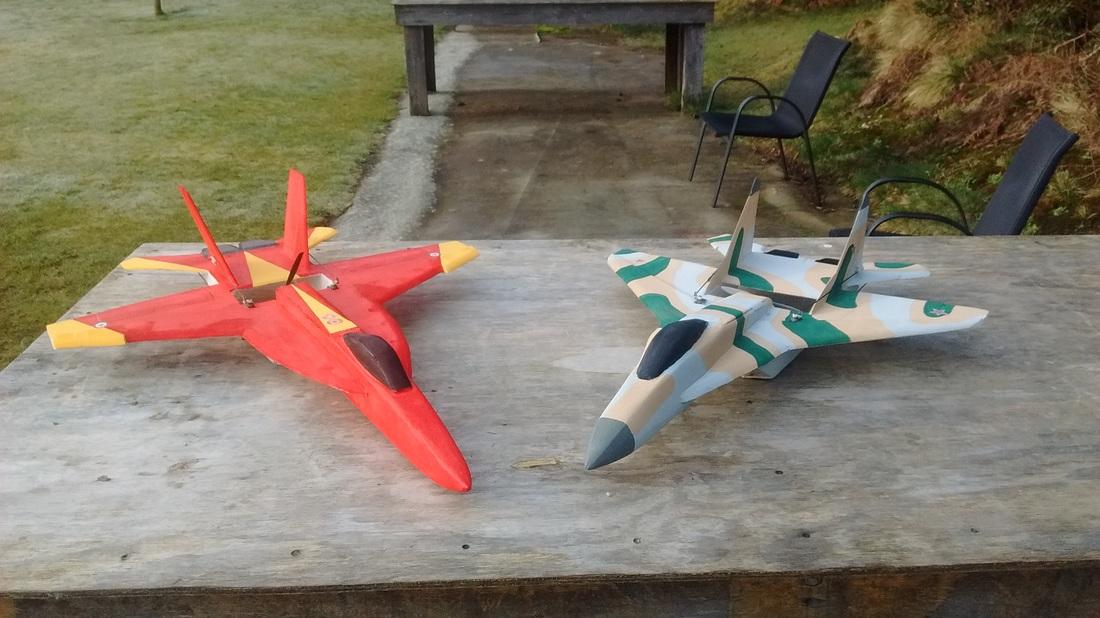
In the picture above comparing the RCP F-18 V3 and NAMC Mig-35B, you can see what I mean by the difference in placement angle of the vertical stabilizers.  Planes with the angled stabilizers like the F-18 tend to be less stable in windier conditions.  The tail will tend to "wag" like a dog's tail going into wind and in turns.  It definitely helps having rudders on planes with this sort of tail configuration to help keep the nose tracking true through corners.

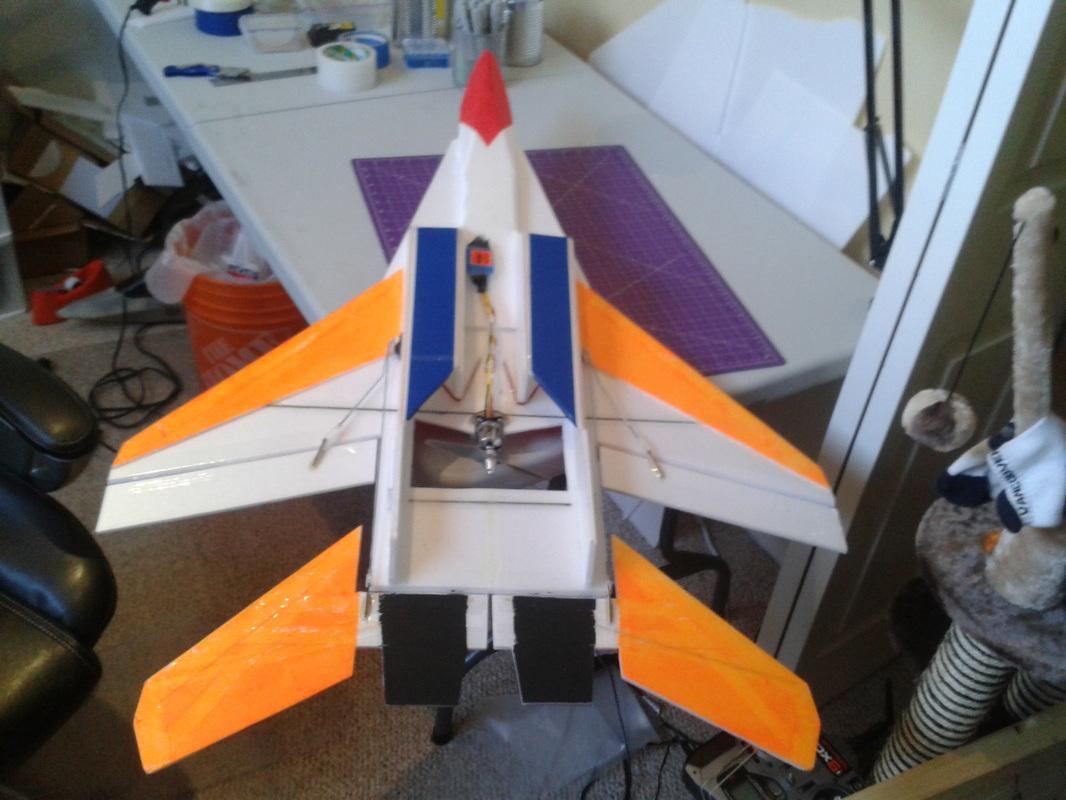
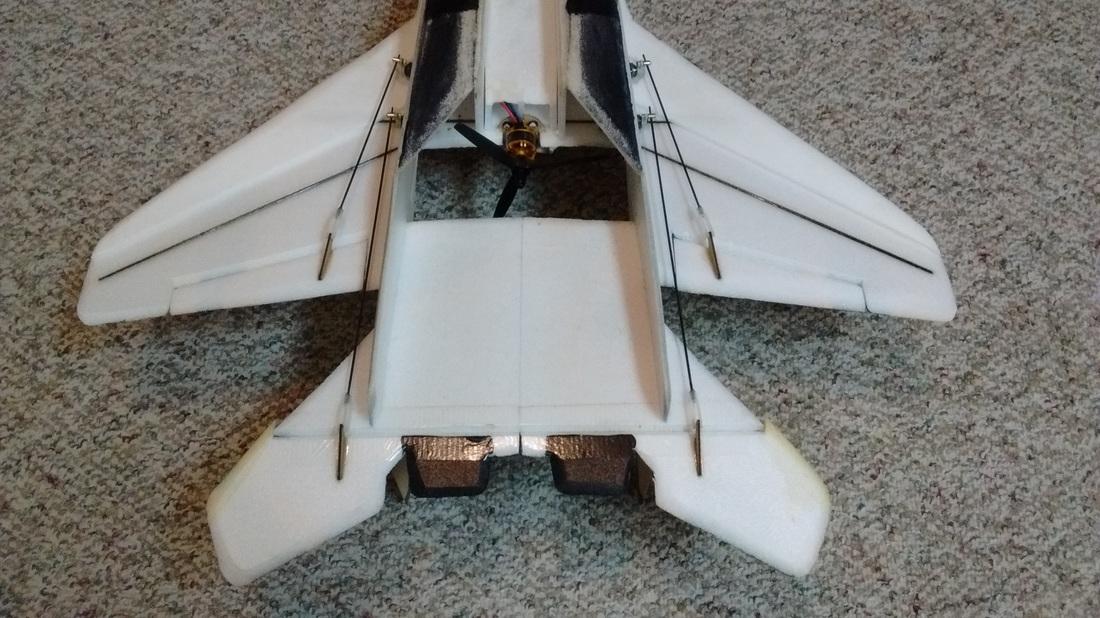
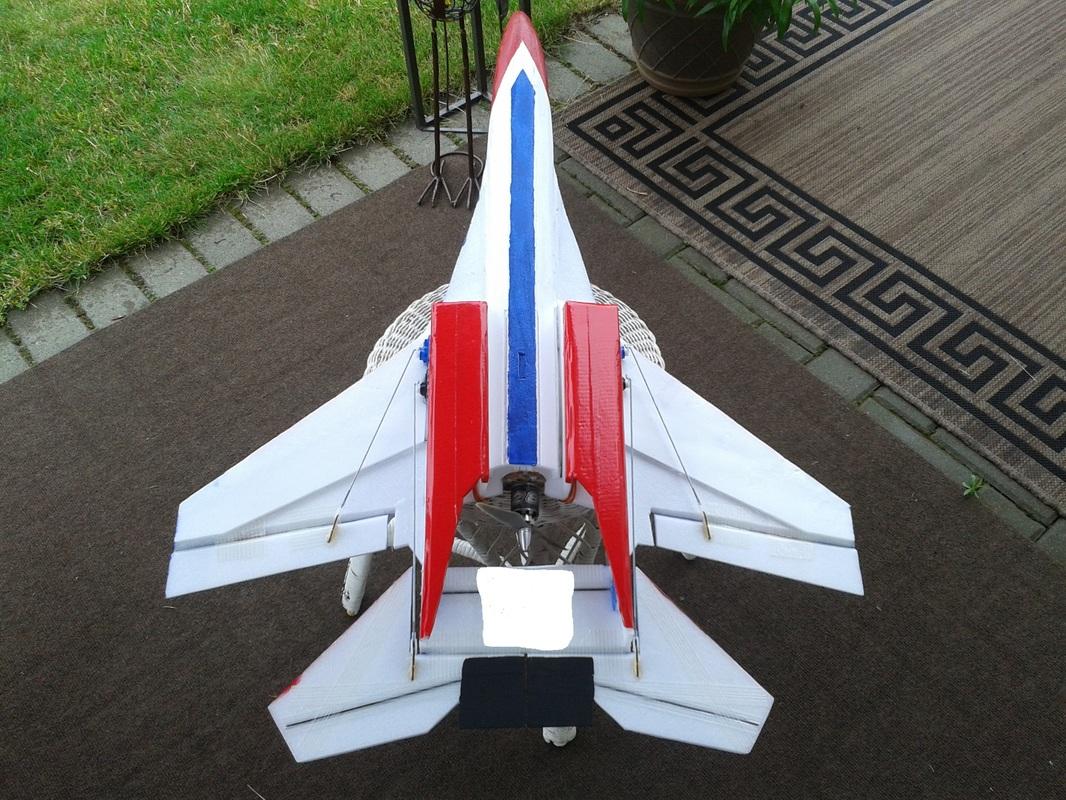
Another thing to consider with the vertical stabilizers is whether they are completely parallel to each other or "toed in".  RC Powers introduced the idea of toeing in the vertical stabilizers to create a slight "wedge" to improve yaw stability with the Mig-29 V3 (now discontinued) Again, it isn't exactly scale, but another minor innovation that makes major improvement.  I found this picture that allows you to look from the top down on the vertical stabilizers and I think makes it very easy to see the "wedge" created by the toed in vertical stabilizers on a NAMC Mig-35B.
Picture
Again, not the most scale look, but it is a matter here of what the wind "sees" as opposed to what the eye sees.  This wedge creates a noticeable increase in yaw and overall stability versus planes that do not have this feature.

When discussing rudders, they can be a very polarizing topic.  Much of the community feels they are not required and never uses them, which is fine.  I would say that in general I use rudders about 5% of the time, but when I need them, I am very glad I have them.  Since I started using them full time about four years ago, my left thumb certainly uses them probably more than I realize to feather in just slight amounts of yaw control as I fly.  Certainly if you like to fly very slow or want to practice high alpha, I would say they are pretty much a must have.  Another area I find them very useful is flying in windy conditions as turning in crosswinds sometimes the tail will drop or slide high, so being able to feather in a bit of rudder really helps keep the turns smooth and the plane under complete control.  So regardless of the extra weight of a couple of servos, I always like to have rudders when I can.

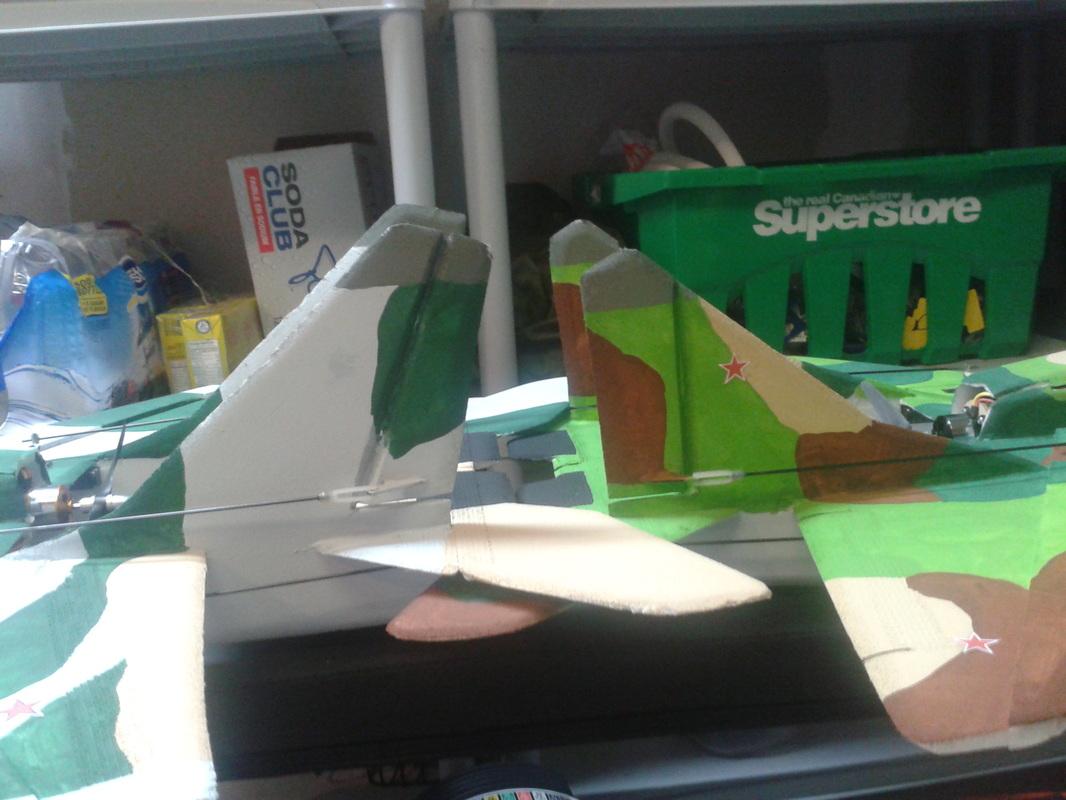
When Stephan and I first met and started sharing ideas, he was tinkering with the RCP Mig-29 V3 in a project he called KnEX (Knife edge experimental) where he was working on a rudder configuration to get the Mig-29 to knife edge.  He had some very good success, but what came out of that experimenting is that the orientation of the rudder hinge line is very crucial to the effectiveness and efficiency of the rudder in the yaw axis.
Picture
In the picture above, the plane on the left is the stock RC Powers Mig-29 V4, on the right is one of the first prototypes of the NAMC Mig-35A.  You can see quite a difference in the rudder hinge angle.  What happens with the angled hinge line is that with rudder input, considerable roll is also induced in the direction of rudder deflection meaning opposite roll input has to be applied to keep the plane from doing a "rudder roll".  Not an efficient or effective form of yaw control as it can cause real issues especially when slow, inducing tip stall much more easily in high alpha.  With the hinge line being vertically oriented, this tendency is greatly reduced, yaw control is much more effective and efficient with minimal to no opposite roll input being required.  Rudder control at slow speeds and high alpha is greatly improved.

Although this is a bit of an aside perhaps, but I wanted to mention the unique "under rudders" on the RC Powers F-22 V5. They are definitely not scale, but work really, really well with the unique stealth layout of the F-22.  You can see them here in this picture, not big, but very efficient at all angles of attack whereas conventional rudders on a stealth plane like the F-22 can get blocked from the airflow by the wing and horizontal stabilizers.
Picture
​So I know this has been a rather lengthy and involved article, but certainly stabilizers and control surfaces are very important to consider in choosing a park jet.  They are either working well with the rest of the overall package of the airplane or working against it in my experience, but are also fairly simple to modify if you like to tinker with your planes to maximize your flying experience.  

In the next article, I will discuss my experiences with some more advanced things like leading edge flaps and canards.  I don't have a lot of experience with these, but will share my thoughts on how they have impacted my flight experience with planes I have built and flown.


Park Jet noise...the "other" sound of freedom😎
Cheers,

Scott