Hi Everyone -
I will caveat this article with a bit of my personal opinion about where I think park jets fit into the grand scheme of things as it applies to control surface size. If you strive to fly park jets in a scale manner, in other words similar to how the real planes fly, I think they fall into the sport/aerobatic realm. Unfortunately for awhile many park jets were being designed with 3D size control surfaces. Certainly if you want to fly a park jet non scale and opt for crazy tumble flips and rifle bullet rolls, that is your choice, but if you are a beginner or want to fly with more precision, over sized control surfaces can make your flying experience more difficult. I certainly did this type of flying when I first got into park jets, but found it not terribly satisfying after awhile as I was just slamming the sticks around doing crazy non scale maneuvers and my true flying skill really didn't improve. As soon as I started trying to focus on smoother flying, more scale turns, loops, rolls and other aerobatics, my skills and confidence improved and I found my level of satisfaction increased greatly. I am still constantly trying to fly the perfect loop, roll and keep my turns silky smooth, overall it has just made the flying experience much better for me anyway.
Essentially there are two types of stabilizers (not the electronic kind that acts as a gyro😉) that are popular in most park jets. The horizontal stabilizer to which the elevons are attached and the vertical stabilizer to which the rudders are attached.
There are the three control surfaces, elevons, ailerons and rudders. As mentioned very early in this thread, most park jets will fly quite well with elevons only, but for more advanced handling and aerobatics, a builder/pilot really needs to consider activating ailerons and rudders.
In this article, I won't be discussing other control or lift devices like leading edge flaps/slats or canards, those will get their own article.
Depending on your transmitter's capabilities and your imagination, the mixing possibilities for ailerons and rudders are considerable. The ailerons can be used as spoilers/spoilerons where they deflect and stay up to help keep the nose up for advanced flying like high alpha. They can also be used as flaps/flaperons to enhance the lift capability of the wing for better slow speed or to slow the landing approach.
Rudders can also be mixed to act as "V-tails" on twin tail park jets where when you pull up on the pitch input, they both deflect inward increasing the upward deflection of the plane's nose and vice versa, they go out when the stick is pushed forward increasing the downward deflection of the nose. Also, they can be programmed to be switch selectable to act as a form of air brakes where they both deflect in or out depending on what you want the plane to do. From my experience, I would experiment with with these mixes up high first as they could cause your plane to pitch up quickly and stall or pitch down quickly and make it difficult to recover, both behaviors you want to avoid down low or on approach to landing.
So back to the beginning. One of the first things to look at in my experience again is the size of the control surfaces in comparison to the wing. While many people argue that you need very large/over sized control surfaces for better handling at slow speeds, I personally disagree with that theory based on thousands of flights with park jets that have smaller control surfaces that are closer to scale size. Granted with any model of a real plane, control surfaces and stabilizers may not be exactly scale, often without the support of on board computers like the real jets have, designers need to take some licence with the size and sometimes placement of park jet control surfaces and stabilizers to optimize the flight experience. Just based on common sense, the larger the control surface, any time it is deflected, it causes more drag, more turbulence and greater instability, all properties which can take away from the airplane's handling and performance.
Horizontal stabilizers/elevons
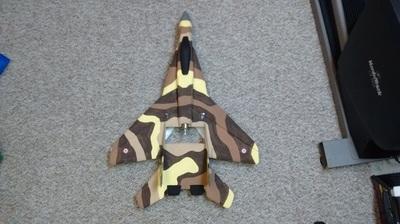
For a very long time, park jets were all designed with "flying" or fully functional elevons similar to the real plane, meaning there was a considerable amount of control surface moving anytime you touched the sticks and no stability features built in. This picture below is of the RC Powers Mig-29 V2 which is no longer available. This airplane was my park jet nemesis 😒 I built three of them and between those three accumulated less than 50 flights, two of them crashing in less than ten flights. Makes you wonder why I love the Mig so much?!😳
I will caveat this article with a bit of my personal opinion about where I think park jets fit into the grand scheme of things as it applies to control surface size. If you strive to fly park jets in a scale manner, in other words similar to how the real planes fly, I think they fall into the sport/aerobatic realm. Unfortunately for awhile many park jets were being designed with 3D size control surfaces. Certainly if you want to fly a park jet non scale and opt for crazy tumble flips and rifle bullet rolls, that is your choice, but if you are a beginner or want to fly with more precision, over sized control surfaces can make your flying experience more difficult. I certainly did this type of flying when I first got into park jets, but found it not terribly satisfying after awhile as I was just slamming the sticks around doing crazy non scale maneuvers and my true flying skill really didn't improve. As soon as I started trying to focus on smoother flying, more scale turns, loops, rolls and other aerobatics, my skills and confidence improved and I found my level of satisfaction increased greatly. I am still constantly trying to fly the perfect loop, roll and keep my turns silky smooth, overall it has just made the flying experience much better for me anyway.
Essentially there are two types of stabilizers (not the electronic kind that acts as a gyro😉) that are popular in most park jets. The horizontal stabilizer to which the elevons are attached and the vertical stabilizer to which the rudders are attached.
There are the three control surfaces, elevons, ailerons and rudders. As mentioned very early in this thread, most park jets will fly quite well with elevons only, but for more advanced handling and aerobatics, a builder/pilot really needs to consider activating ailerons and rudders.
In this article, I won't be discussing other control or lift devices like leading edge flaps/slats or canards, those will get their own article.
Depending on your transmitter's capabilities and your imagination, the mixing possibilities for ailerons and rudders are considerable. The ailerons can be used as spoilers/spoilerons where they deflect and stay up to help keep the nose up for advanced flying like high alpha. They can also be used as flaps/flaperons to enhance the lift capability of the wing for better slow speed or to slow the landing approach.
Rudders can also be mixed to act as "V-tails" on twin tail park jets where when you pull up on the pitch input, they both deflect inward increasing the upward deflection of the plane's nose and vice versa, they go out when the stick is pushed forward increasing the downward deflection of the nose. Also, they can be programmed to be switch selectable to act as a form of air brakes where they both deflect in or out depending on what you want the plane to do. From my experience, I would experiment with with these mixes up high first as they could cause your plane to pitch up quickly and stall or pitch down quickly and make it difficult to recover, both behaviors you want to avoid down low or on approach to landing.
So back to the beginning. One of the first things to look at in my experience again is the size of the control surfaces in comparison to the wing. While many people argue that you need very large/over sized control surfaces for better handling at slow speeds, I personally disagree with that theory based on thousands of flights with park jets that have smaller control surfaces that are closer to scale size. Granted with any model of a real plane, control surfaces and stabilizers may not be exactly scale, often without the support of on board computers like the real jets have, designers need to take some licence with the size and sometimes placement of park jet control surfaces and stabilizers to optimize the flight experience. Just based on common sense, the larger the control surface, any time it is deflected, it causes more drag, more turbulence and greater instability, all properties which can take away from the airplane's handling and performance.
Horizontal stabilizers/elevons
For a very long time, park jets were all designed with "flying" or fully functional elevons similar to the real plane, meaning there was a considerable amount of control surface moving anytime you touched the sticks and no stability features built in. This picture below is of the RC Powers Mig-29 V2 which is no longer available. This airplane was my park jet nemesis 😒 I built three of them and between those three accumulated less than 50 flights, two of them crashing in less than ten flights. Makes you wonder why I love the Mig so much?!😳
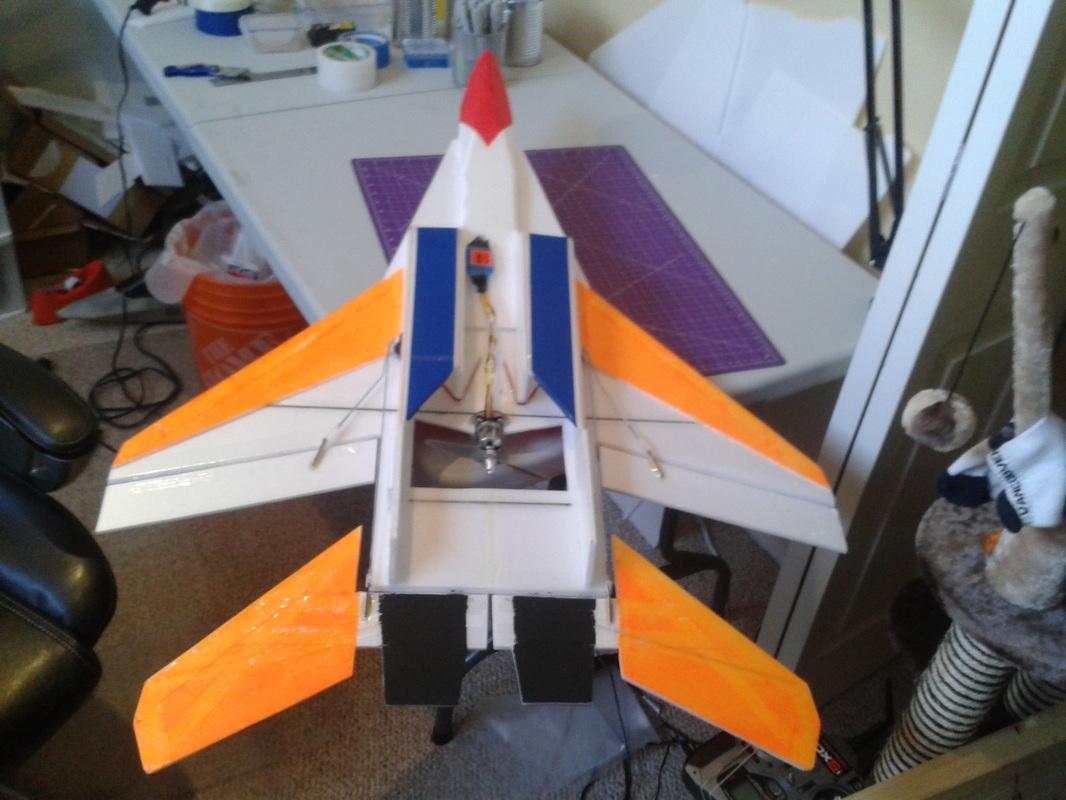
One of the first things that strikes me as I look at this old picture is how huge the elevons are on this plane. They are very close to the same "span" as the wings, very large outboard surfaces and massive amounts of area in the prop wash. No wonder it felt so twitchy 😵 Also of note is how large the ailerons are and how the moving surface extends all the way to the wingtip. In contrast, if you fast forward to the Mig-35B, Stephan designed the elevons to be of scale size, incorporated fixed horizontal stabilizers and the ailerons are much smaller and don't extend to the wingtip (more on that later).
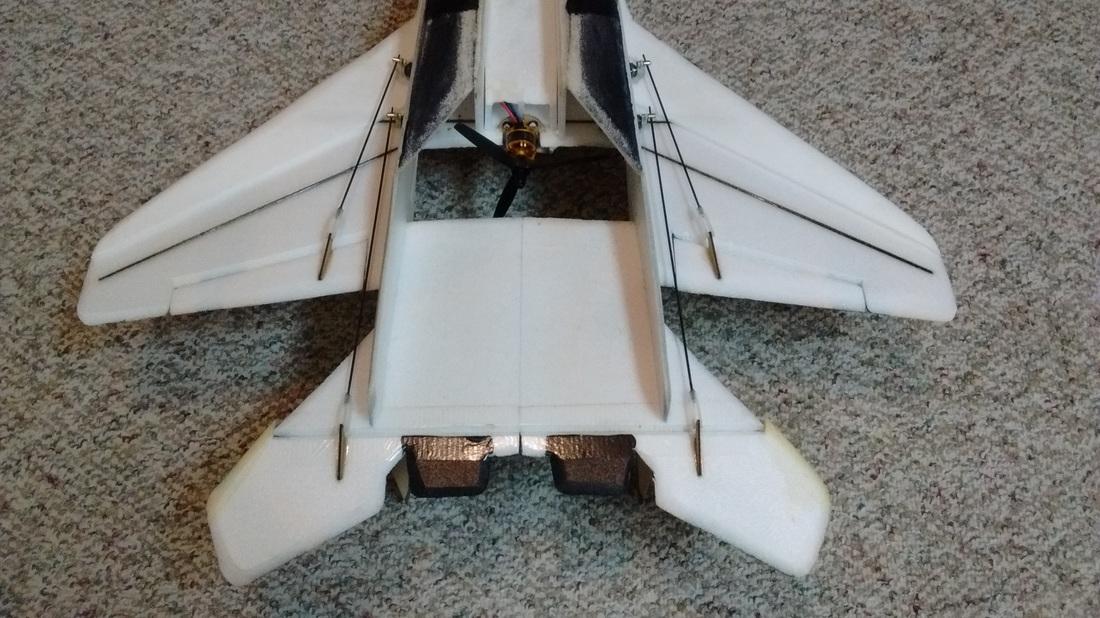
The idea of fixed horizontal stabilizers is certainly not a NAMC idea, RC Powers first introduced the idea with the Mig-29 V4 and Su-34 V4 and I think it is one of the best innovations to come along in park jet design in a very long time and this has been carried over into the V5 lineup by RC Powers as well. When you look at the back end of a park jet, there is already going to be a lot of "dirty air" caused by air flowing over the plane and prop wash, so anything that can be done to improve stability in the back end of the plane is crucial to improving the airplane's handling and performance.
When assessing elevon size, if the span from tip to tip is too large and the surface itself over sized, not only does it cause more frontal drag and slows the plane down, every time a big surface is deflected, it causes more drag, turbulence and instability. With the unique design of a mid mount "prop in slot" over sized elevons can also act as speed brakes, get too slow, pull back too hard on the stick, they act more as speed brakes, parking the plane in the air and on comes stall quite quickly and hammering the power just worsens the problem unless you have enough wherewithal to also let off pitch input as you accelerate.
So since almost any park jet I have ever flown flies quite well elevons only, these are very important to consider from a standpoint of size and whether the design has fixed horizontal stabilizers. Smaller, scale size elevons work very well, you obviously need to add a bit more throw in the roll axis since you don't have ailerons helping in turns and rolls.
Fortunately, since the RC Powers V2s, many designers are starting to produce planes with much more scale size elevons and are even incorporating the horizontal stabilizers that RC Powers introduced.
Ailerons
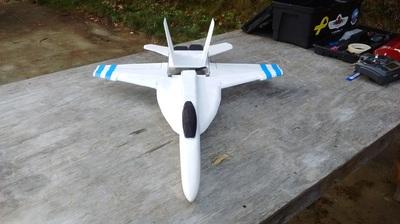
As you can see from the first picture above of the Mig-29 V2, the ailerons are quite large and extend all the way to the end of the wing tip. They are essentially what you would see in a 3D plane and make precision flying very difficult as there is so much control surface entering the slip stream every time roll input is made. What also happens with these full length ailerons is as you get slow and give roll input, having that area deflected close to the wing tip can bring on tip stall much more quickly. If you look at this plane below, the ailerons are actually wider at the tip, I found this plane had a tendency to tip stall quite quickly if I got slow and put in any roll input, the wider aileron at the tip caused more force and would tip the wing over quite aggressively compared to more uniform size ailerons.
When assessing elevon size, if the span from tip to tip is too large and the surface itself over sized, not only does it cause more frontal drag and slows the plane down, every time a big surface is deflected, it causes more drag, turbulence and instability. With the unique design of a mid mount "prop in slot" over sized elevons can also act as speed brakes, get too slow, pull back too hard on the stick, they act more as speed brakes, parking the plane in the air and on comes stall quite quickly and hammering the power just worsens the problem unless you have enough wherewithal to also let off pitch input as you accelerate.
So since almost any park jet I have ever flown flies quite well elevons only, these are very important to consider from a standpoint of size and whether the design has fixed horizontal stabilizers. Smaller, scale size elevons work very well, you obviously need to add a bit more throw in the roll axis since you don't have ailerons helping in turns and rolls.
Fortunately, since the RC Powers V2s, many designers are starting to produce planes with much more scale size elevons and are even incorporating the horizontal stabilizers that RC Powers introduced.
Ailerons
As you can see from the first picture above of the Mig-29 V2, the ailerons are quite large and extend all the way to the end of the wing tip. They are essentially what you would see in a 3D plane and make precision flying very difficult as there is so much control surface entering the slip stream every time roll input is made. What also happens with these full length ailerons is as you get slow and give roll input, having that area deflected close to the wing tip can bring on tip stall much more quickly. If you look at this plane below, the ailerons are actually wider at the tip, I found this plane had a tendency to tip stall quite quickly if I got slow and put in any roll input, the wider aileron at the tip caused more force and would tip the wing over quite aggressively compared to more uniform size ailerons.
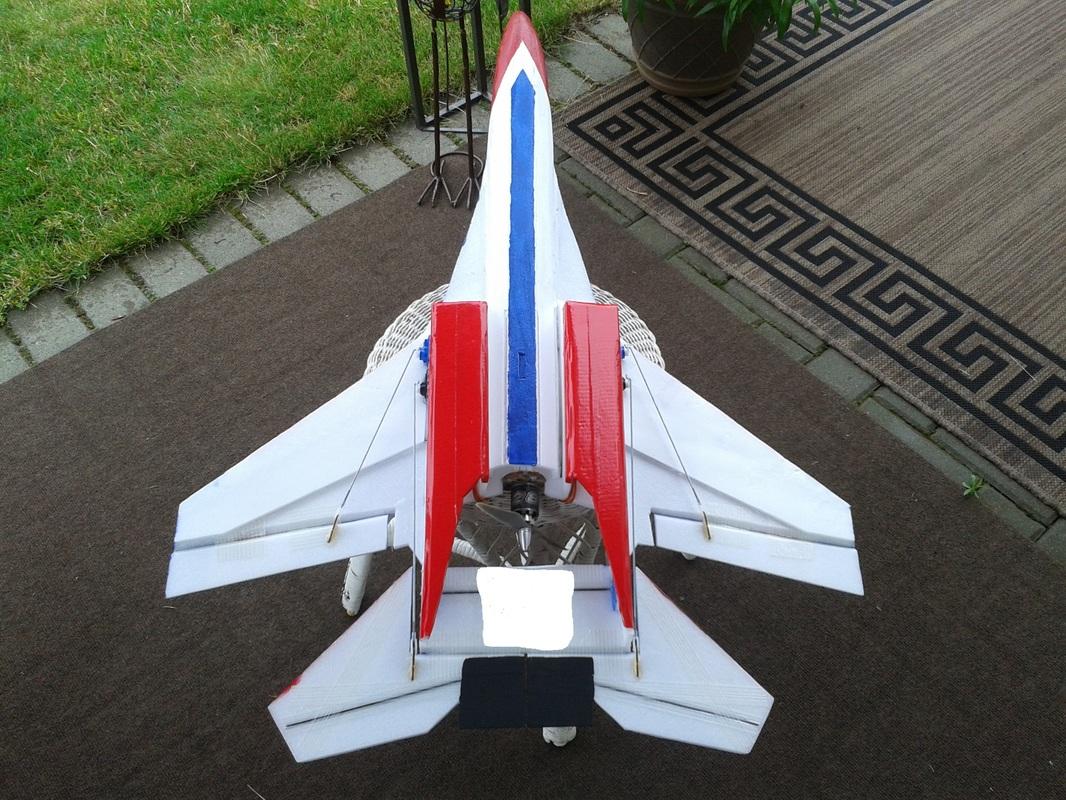
When Stephan and I were tinkering with the RC Powers Mig-29 V4 which led to the NAMC Mig-35, we experimented with several different sizes and shapes of ailerons and found the ones you see in the picture of the Mig-35B above seem to work the best. In essence they are probably "maneuvering flaps" more than anything else and not exactly scale in size, shape and position, but give great flexibility in increasing roll rates, and in use as flaps/flaperons/spoilers/spoilerons. They are certainly not needed, but for more advanced aerobatics, they certainly do help out. We have found that having inboard ailerons/maneuvering flaps that are about 60% of the total trailing edge of the wing seem to work the most efficiently.
Vertical stabilizers/rudders
In my experience, twin tail park jets like Migs, Sukhois, F-15, F-18, F-22 tend to be more stable in the yaw axis than single tail planes like the F-16, Rafale, Eurofighter. Obviously, having almost double the area of stabilizer helps as does allowing for a more clean flow of prop wash without it being split and made even more turbulent by a single tail cutting it in half.
In general, planes with vertical stabilizers that are perpendicular to the wing plate like Migs, Sukhois, F-15 are more stable than planes like the F-18 and F-22.
Vertical stabilizers/rudders
In my experience, twin tail park jets like Migs, Sukhois, F-15, F-18, F-22 tend to be more stable in the yaw axis than single tail planes like the F-16, Rafale, Eurofighter. Obviously, having almost double the area of stabilizer helps as does allowing for a more clean flow of prop wash without it being split and made even more turbulent by a single tail cutting it in half.
In general, planes with vertical stabilizers that are perpendicular to the wing plate like Migs, Sukhois, F-15 are more stable than planes like the F-18 and F-22.
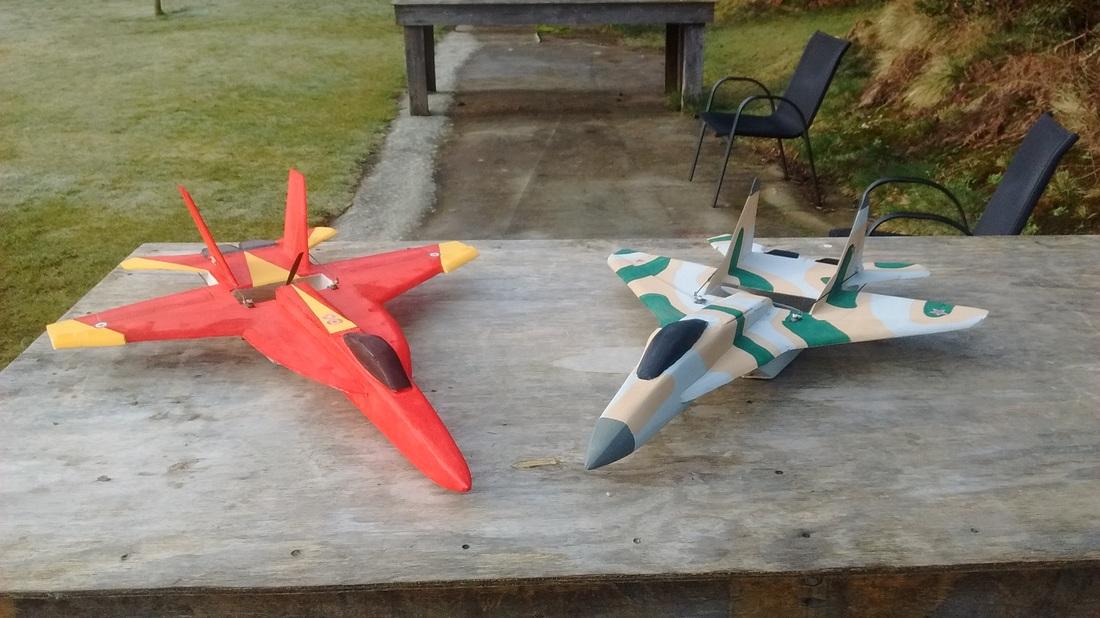
In the picture above comparing the RCP F-18 V3 and NAMC Mig-35B, you can see what I mean by the difference in placement angle of the vertical stabilizers. Planes with the angled stabilizers like the F-18 tend to be less stable in windier conditions. The tail will tend to "wag" like a dog's tail going into wind and in turns. It definitely helps having rudders on planes with this sort of tail configuration to help keep the nose tracking true through corners.
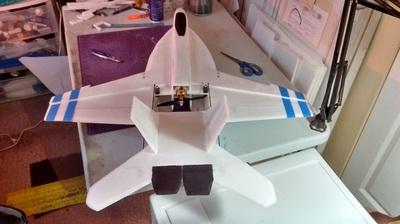
Another thing to consider with the vertical stabilizers is whether they are completely parallel to each other or "toed in". RC Powers introduced the idea of toeing in the vertical stabilizers to create a slight "wedge" to improve yaw stability with the Mig-29 V3 (now discontinued) Again, it isn't exactly scale, but another minor innovation that makes major improvement. I found this picture that allows you to look from the top down on the vertical stabilizers and I think makes it very easy to see the "wedge" created by the toed in vertical stabilizers on a NAMC Mig-35B.
Another thing to consider with the vertical stabilizers is whether they are completely parallel to each other or "toed in". RC Powers introduced the idea of toeing in the vertical stabilizers to create a slight "wedge" to improve yaw stability with the Mig-29 V3 (now discontinued) Again, it isn't exactly scale, but another minor innovation that makes major improvement. I found this picture that allows you to look from the top down on the vertical stabilizers and I think makes it very easy to see the "wedge" created by the toed in vertical stabilizers on a NAMC Mig-35B.
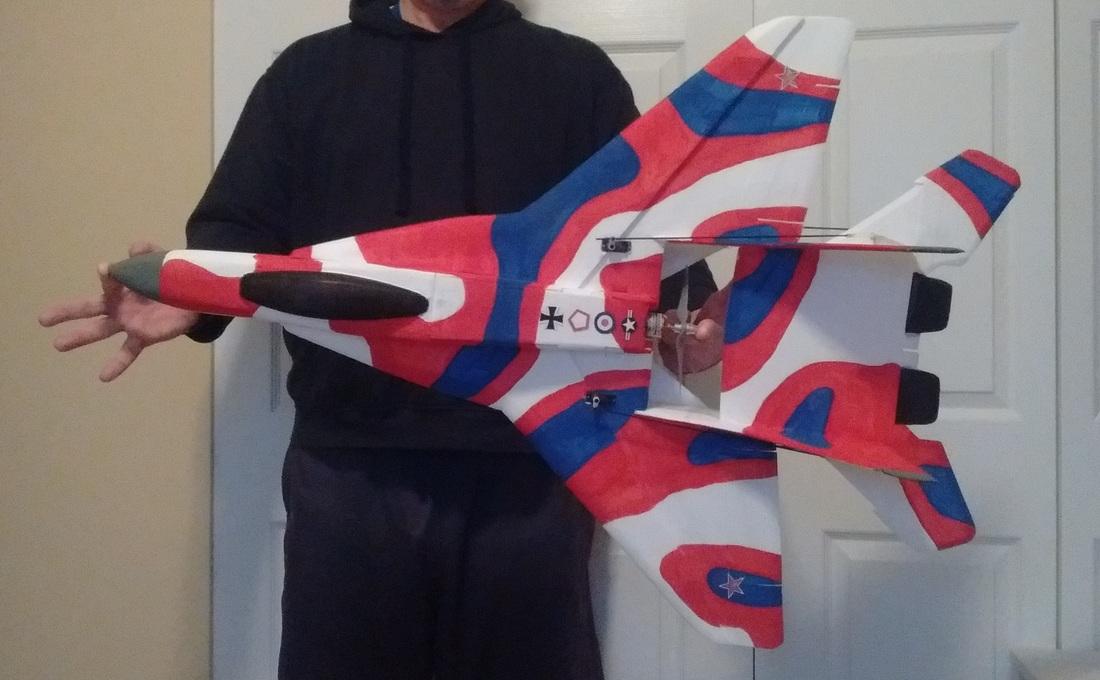
Again, not the most scale look, but it is a matter here of what the wind "sees" as opposed to what the eye sees. This wedge creates a noticeable increase in yaw and overall stability versus planes that do not have this feature.
When discussing rudders, they can be a very polarizing topic. Much of the community feels they are not required and never uses them, which is fine. I would say that in general I use rudders about 5% of the time, but when I need them, I am very glad I have them. Since I started using them full time about four years ago, my left thumb certainly uses them probably more than I realize to feather in just slight amounts of yaw control as I fly. Certainly if you like to fly very slow or want to practice high alpha, I would say they are pretty much a must have. Another area I find them very useful is flying in windy conditions as turning in crosswinds sometimes the tail will drop or slide high, so being able to feather in a bit of rudder really helps keep the turns smooth and the plane under complete control. So regardless of the extra weight of a couple of servos, I always like to have rudders when I can.
When Stephan and I first met and started sharing ideas, he was tinkering with the RCP Mig-29 V3 in a project he called KnEX (Knife edge experimental) where he was working on a rudder configuration to get the Mig-29 to knife edge. He had some very good success, but what came out of that experimenting is that the orientation of the rudder hinge line is very crucial to the effectiveness and efficiency of the rudder in the yaw axis.
When discussing rudders, they can be a very polarizing topic. Much of the community feels they are not required and never uses them, which is fine. I would say that in general I use rudders about 5% of the time, but when I need them, I am very glad I have them. Since I started using them full time about four years ago, my left thumb certainly uses them probably more than I realize to feather in just slight amounts of yaw control as I fly. Certainly if you like to fly very slow or want to practice high alpha, I would say they are pretty much a must have. Another area I find them very useful is flying in windy conditions as turning in crosswinds sometimes the tail will drop or slide high, so being able to feather in a bit of rudder really helps keep the turns smooth and the plane under complete control. So regardless of the extra weight of a couple of servos, I always like to have rudders when I can.
When Stephan and I first met and started sharing ideas, he was tinkering with the RCP Mig-29 V3 in a project he called KnEX (Knife edge experimental) where he was working on a rudder configuration to get the Mig-29 to knife edge. He had some very good success, but what came out of that experimenting is that the orientation of the rudder hinge line is very crucial to the effectiveness and efficiency of the rudder in the yaw axis.
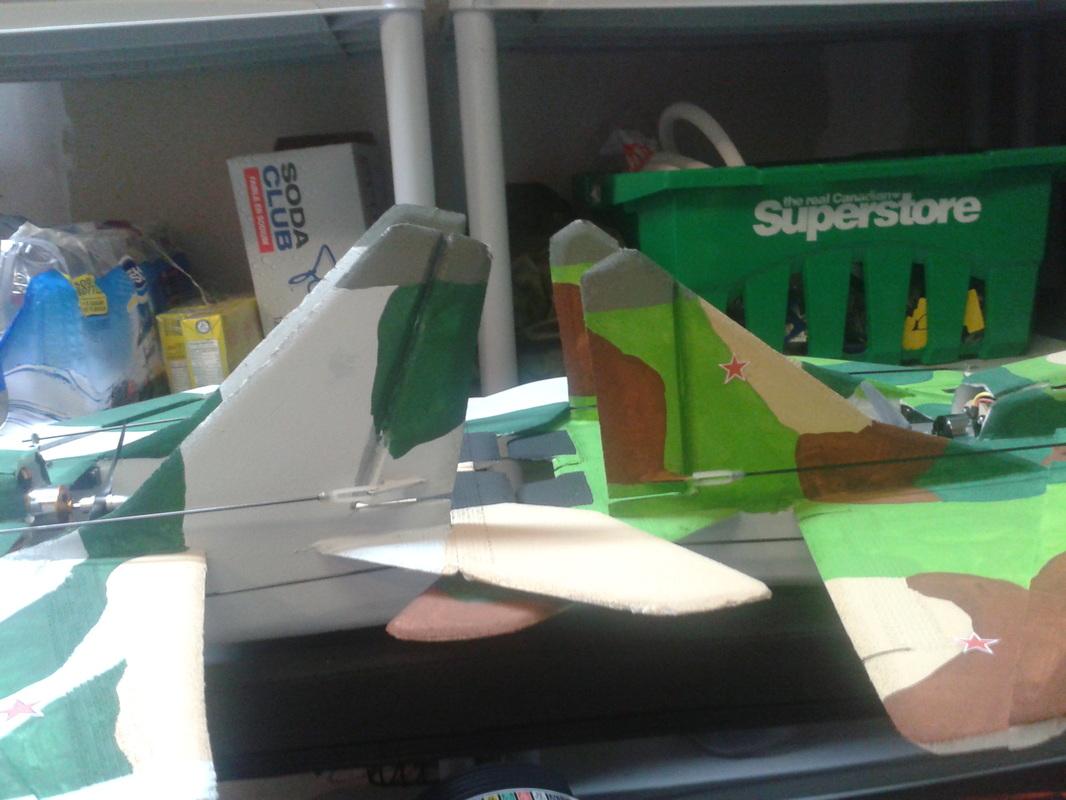
In the picture above, the plane on the left is the stock RC Powers Mig-29 V4, on the right is one of the first prototypes of the NAMC Mig-35A. You can see quite a difference in the rudder hinge angle. What happens with the angled hinge line is that with rudder input, considerable roll is also induced in the direction of rudder deflection meaning opposite roll input has to be applied to keep the plane from doing a "rudder roll". Not an efficient or effective form of yaw control as it can cause real issues especially when slow, inducing tip stall much more easily in high alpha. With the hinge line being vertically oriented, this tendency is greatly reduced, yaw control is much more effective and efficient with minimal to no opposite roll input being required. Rudder control at slow speeds and high alpha is greatly improved.
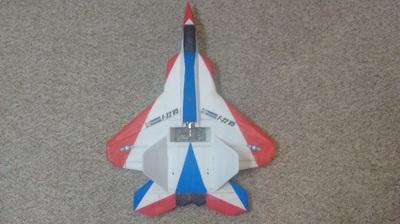
Although this is a bit of an aside perhaps, but I wanted to mention the unique "under rudders" on the RC Powers F-22 V5. They are definitely not scale, but work really, really well with the unique stealth layout of the F-22. You can see them here in this picture, not big, but very efficient at all angles of attack whereas conventional rudders on a stealth plane like the F-22 can get blocked from the airflow by the wing and horizontal stabilizers.
Although this is a bit of an aside perhaps, but I wanted to mention the unique "under rudders" on the RC Powers F-22 V5. They are definitely not scale, but work really, really well with the unique stealth layout of the F-22. You can see them here in this picture, not big, but very efficient at all angles of attack whereas conventional rudders on a stealth plane like the F-22 can get blocked from the airflow by the wing and horizontal stabilizers.
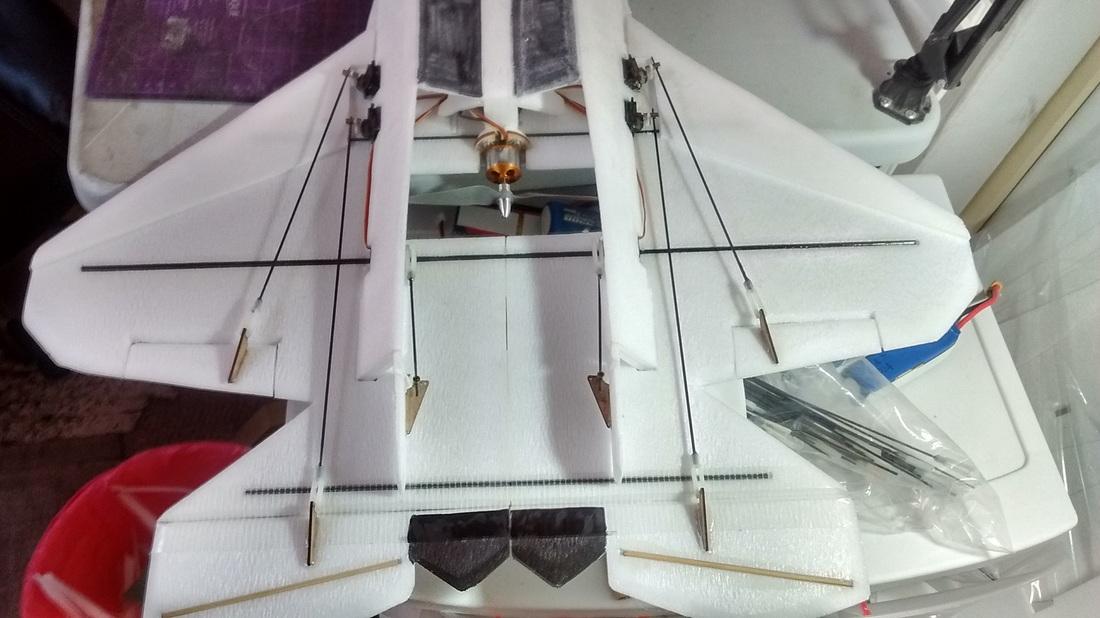
So I know this has been a rather lengthy and involved article, but certainly stabilizers and control surfaces are very important to consider in choosing a park jet. They are either working well with the rest of the overall package of the airplane or working against it in my experience, but are also fairly simple to modify if you like to tinker with your planes to maximize your flying experience.
In the next article, I will discuss my experiences with some more advanced things like leading edge flaps and canards. I don't have a lot of experience with these, but will share my thoughts on how they have impacted my flight experience with planes I have built and flown.
Park Jet noise...the "other" sound of freedom😎
Cheers,
Scott
In the next article, I will discuss my experiences with some more advanced things like leading edge flaps and canards. I don't have a lot of experience with these, but will share my thoughts on how they have impacted my flight experience with planes I have built and flown.
Park Jet noise...the "other" sound of freedom😎
Cheers,
Scott